An independent guide, not an installer
Solar Panel Installer Widnes: an independent guide to planning, connecting and choosing
Written for Victorian terraces in Appleton, inter-war semis, post-war estates, newer homes in Birchfield
Widnes grew from a village of about 2,200 people in 1841 into a chemical town of around 30,000 by 1891, and its homes still carry that history: a third of households live in a terrace. This guide covers the roofs, the rules and the money, with a checker for the question most quotes skip: how your system will be connected to the grid, and what the inverter size costs you.
PVGIS 5.3 for Widnes; SP Energy Networks; ONS Census 2021; DESNZ (the constituency includes Halewood).
The connection question most quotes skip
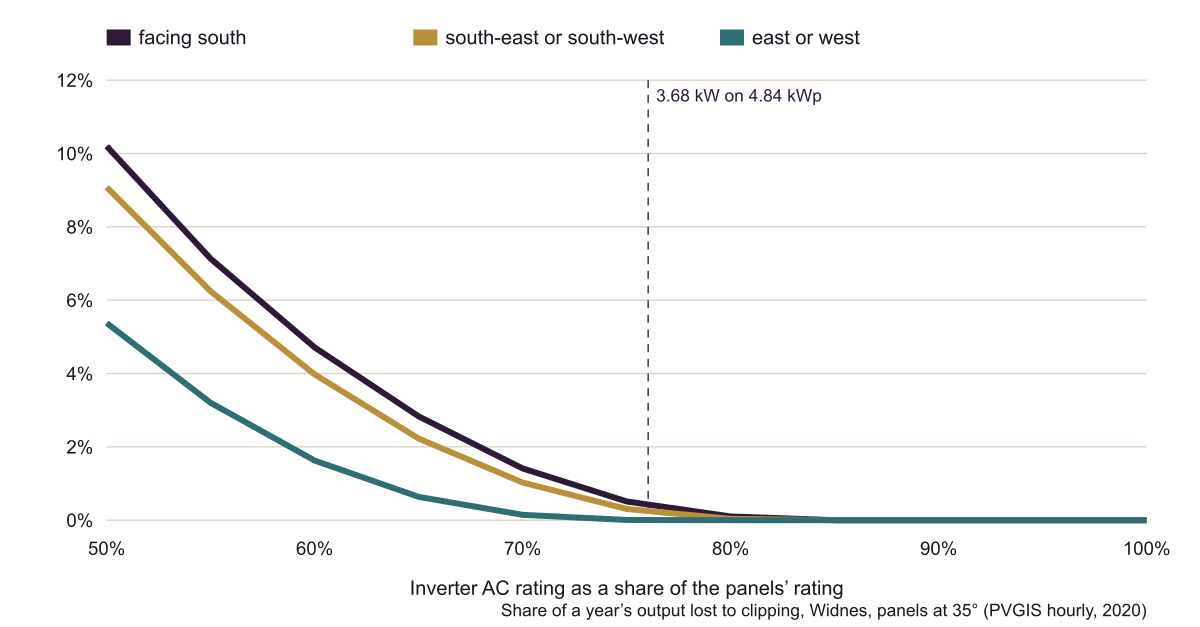
Every grid-tied system is reported to SP Energy Networks, which runs the cables in Widnes. The route depends on what the inverters can send out, not on the panels' rating. A typical choice is eleven 440 W panels, 4.84 kWp, on a 3.68 kW inverter: that stays on the connect-then-notify route, and PVGIS hourly figures for Widnes put the energy clipped by the smaller inverter at about 0.4% of the year.
Add a battery with its own 3 kW inverter and the total that could export becomes 6.68 kW, so the installer must apply first. A 5 kW hybrid inverter with a 3.68 kW export cap needs an application too. The connection checker runs these sums for your own panels, inverter and supply.
Widnes's homes and their roofs
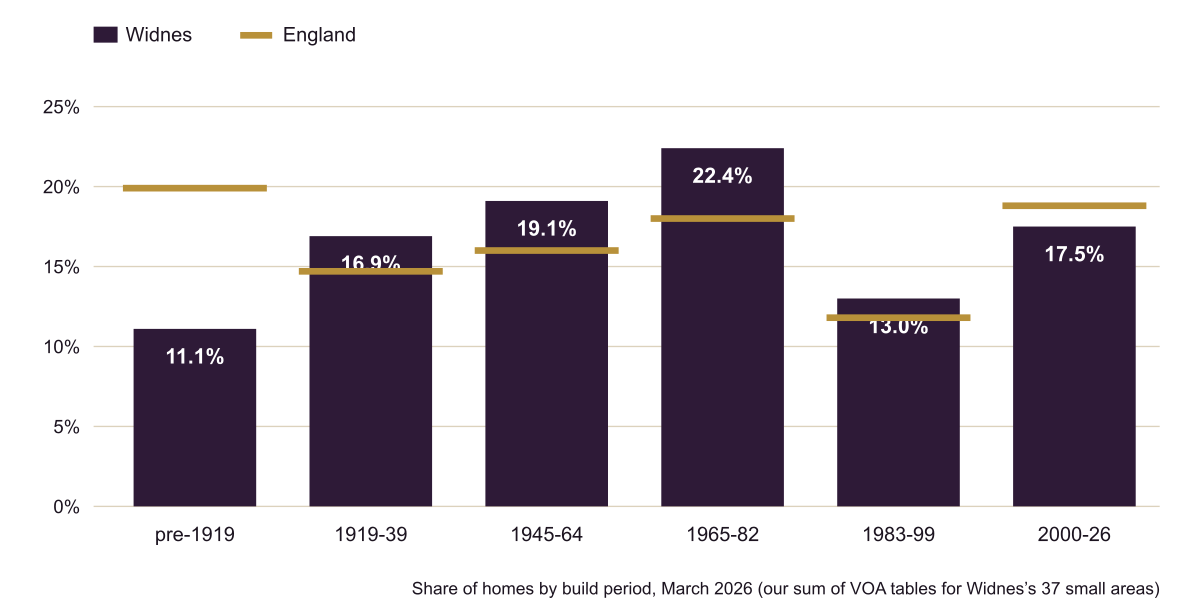
The first chemical works opened in 1849, and terraces went up around Newtown and Simm's Cross as the town filled with workers; Appleton was where the works owners built. Our sum of council tax records puts 16.9% of Widnes homes in the years 1919 to 1939 and 19.1% in 1945 to 1964, both above the shares for England. In the 2021 Census, 34.4% of households lived in a semi and 21.5% in a detached house.
Homes across Widnes
Nine wards, from Birchfield's detached houses to the terraces of Appleton.
Victorian terraces
Narrow slopes, chimneys and party walls: how to fit panels around them.
Planning and conservation
Permitted development, and the five conservation areas on the Widnes side.
Widnes solar figures
Ratings, house types and how many homes have panels already.
The year's sunshine, month by month
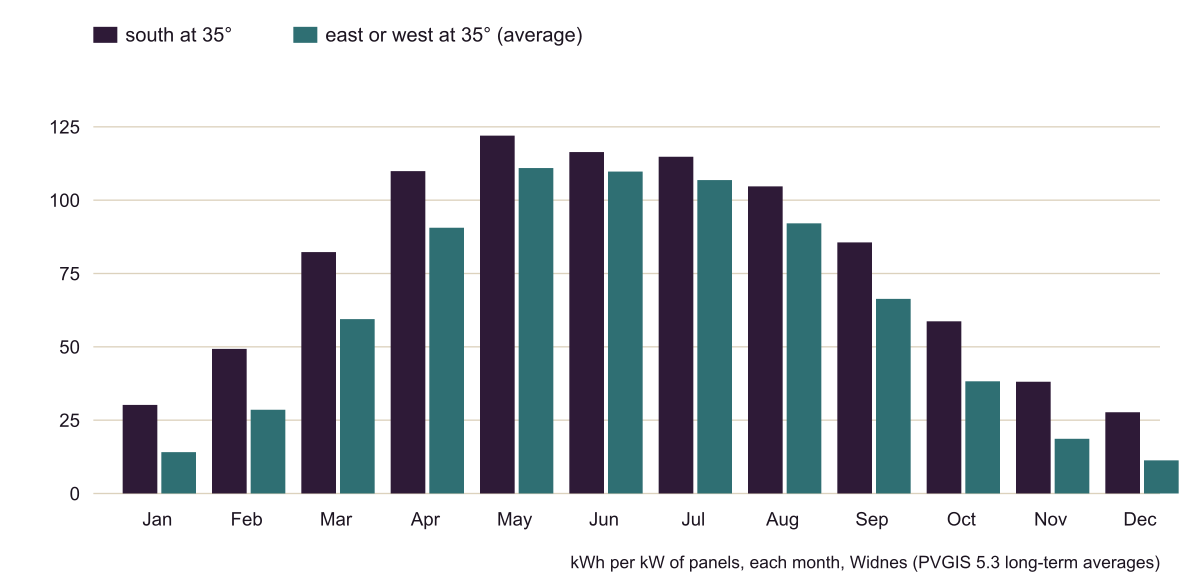
PVGIS, the European Commission's solar model, puts a south-facing panel at 35 degrees in Widnes at about 940 kWh a year for each kW. May is the best month and December the worst, with roughly four times as much in the one as the other. East and west roofs make about 79% of the south-facing figure over a year, more evenly spread across the day.
Where in Widnes you live hardly matters: PVGIS gives West Bank, Ditton, Farnworth, Upton Rocks and Halton View the same figure to within a fraction of a per cent. Direction, tilt and shade decide the output. The Met Office station at Hawarden records about 1,573 hours of sunshine a year.
See batteries and the grid for what the summer surplus means for storage.
The rules that apply in Widnes
Planning
Panels on a house roof are usually permitted development if they stand no more than 0.2 m proud and below the ridge. Details on planning and conservation.
Conservation areas
Victoria Square, West Bank Promenade, Hale Road, Hale Village and Halebank: panels on a wall facing the road there need permission.
The network
SP Energy Networks for the whole borough. Up to 3.68 kW of inverters per phase: connect, then notify. More: apply first. See G98 and G99.
Export limits
A cap on what goes back to the grid can make a larger system acceptable. What it costs is on export limits.
Prices, value and help with costs
Solar panels are an asset rather than a running cost: once paid for, every unit they make costs nothing, and its value depends on whether you use it in the house or send it to the grid. The money pages set out that sum for Widnes with every assumption visible.
Prices
£1,800 per kW up to 4 kW and £1,627 for 4 to 10 kW across the North West (DESNZ 2025/26).
Is it worth it?
A first year for south and east-west roofs at the current price cap.
Grants and loans
Halton and the city region list solar panels in the Warm Homes: Local Grant for eligible homes rated D to G.
Getting paid for exports
Meters, export tariffs and what an export limit means for them.
Choosing the firm
Panels are no longer unusual here. DESNZ counted 2,143 domestic solar installations in the Widnes and Halewood constituency by September 2026, about 5.4 for every hundred households counted there in 2021; the constituency takes in Halewood too, so the Widnes figure on its own will differ a little. A neighbour with panels is a good source of questions to ask, though not a reason to skip the checks below.
Because this guide sells nothing, it can be plain about judging those who do. Look for a firm that visits before it prices, names every component, and tells you in writing which connection route the system will take and whether an export limit comes with it. A quote that is silent on the inverter's size, or on the network, leaves the most technical decision to chance.
- Choosing an installer: registers, the visit, the quote.
- Reading an inverter datasheet: the numbers to check.
- Inverter sizing: how small is too small.
- After switch-on: paperwork, monitoring and upkeep.
More from the guide
Sources checked on 3 November 2026: PVGIS 5.3, European Commission Joint Research Centre: long-term yearly output for Widnes by tilt and direction · PVGIS 5.3 hourly series for Widnes, 2020: the basis for the clipping and export-limit figures · DESNZ solar PV cost data, 2025/26: prices per kW by region and size · DESNZ solar deployment, October 2026: domestic installations by constituency · SP Energy Networks, connections: small generation and how to notify or apply · GPDO 2015, Schedule 2 Part 14: renewable energy on houses (legislation.gov.uk) · ONS Census 2021, built-up area tables: Widnes (E63001425) · Cheshire Historic Towns Survey: Widnes archaeological assessment (Shaw and Clark, 2003).
Questions from Widnes homeowners
Is this site a solar panel installer?
No. Solar Panel Installer Widnes is an independent guide published by SEO-DONS LTD. It does not sell, survey or fit anything, and it does not hand your details to installers.
How much will solar panels make in Widnes?
PVGIS gives a south-facing roof at 35 degrees about 940 kWh a year for every kW of panels, and an east or west roof about 747. Eleven 440 W panels facing south would make roughly 4,529 kWh a year.
Does my installer need permission from the network to connect?
Not for most home systems. If the inverters together can send out no more than 3.68 kW on an ordinary single-phase supply, the installer connects and then notifies SP Energy Networks (G98). Bigger systems, or a battery with its own inverter added to a 3.68 kW one, need approval first (G99).
How much do solar panels cost in Widnes?
DESNZ put the 2025/26 North West average at £1,800 per kW for systems up to 4 kW and £1,627 per kW from 4 to 10 kW. At those averages, 4.84 kW comes to about £7,875.
Will an export limit waste my electricity?
Usually very little. On 14 panels with a 5 kW inverter capped at 3.68 kW, PVGIS hourly figures for Widnes put the most that could be lost at about 4.8% of the year's output, and only if nothing at all were used in the house at those times.
A quote, an inverter or a connection question about your Widnes home?
Tell us what you are weighing up, with your Widnes postcode. The message goes to SEO-DONS LTD, which publishes this independent guide, and the answer comes back by email. Asking costs nothing and binds you to nothing.
What happens next
- Send the form; your postcode tells us which part of Widnes the roof is in.
- We read what you sent and reply by email with the figures and sources that apply.
- Whether you go ahead, and with which firm, stays your decision.